Who am I to name a field?
How are scientific fields actually named?
I’d never really thought about it until The Experiment Foundation’s Field Building Accelerator application asked me to name the field for the Field Builder grant program. The question stopped me.
Naming an idea built on so much science, by so many scientists, felt a bit like hubris. Who was I to decide what others would call this work?
A name has to withstand the test of time and the collective judgement of the scientific community. And it typically morphs into a “field” only by surviving years of people arguing over definitions, citing each other, and then slowly agreeing they’ve been working on the same thing from different directions.
But someone has to come up with the name and use it first. As I was reading about this year’s Nobel Prize in Physiology or Medicine, I was struck by how the news articles described the prize awarded to the researchers who helped to “open a new field of brain science called optogenetics.” While the very first paper describing the methods was titled “Millisecond-timescale, genetically targeted optical control of neural activity,” Karl Deisseroth gave it the name optogenetics a year later, giving the technical mouthful of the method description a much catchier moniker. The name didn’t come at the end of the work, but near the beginning, far before it was a guarantee that something incredible would come of it.
I’m not saying my science is Nobel-worthy, but reading about the history of how other fields were named made me feel better about the prospect of doing it myself. Not just my grant program, but the community I hope to bring together needs a name that scientists could look at and see their own research questions reflected inside of it. It has to be broad enough to welcome people from different corners of biology and ecology, and specific enough that they would recognize their research as a part of it. More importantly, it needs to be succinct and catchy for it to be adopted widely.
So I got to work. I started with the words and phrases that could explain the work I’m interested in supporting: bringing data from measures of biological processes into the indexes that ecologists use to make predictions about ecosystem health.
My first take:
Biological Threshold Calibration: the development and refinement of thresholds that link environmental conditions or events to ecological or organismal responses, enabling more accurate ecosystem assessment prediction and decision making.
This was helpful to get on paper, but wasn't flexible enough to allow for creative ideas from potential grantees. I was prescribing the methodology too much and I didn't want to pigeonhole people into my way of thinking about thresholds; instead I hoped to find people to follow a general goal, or direction of the collective field.
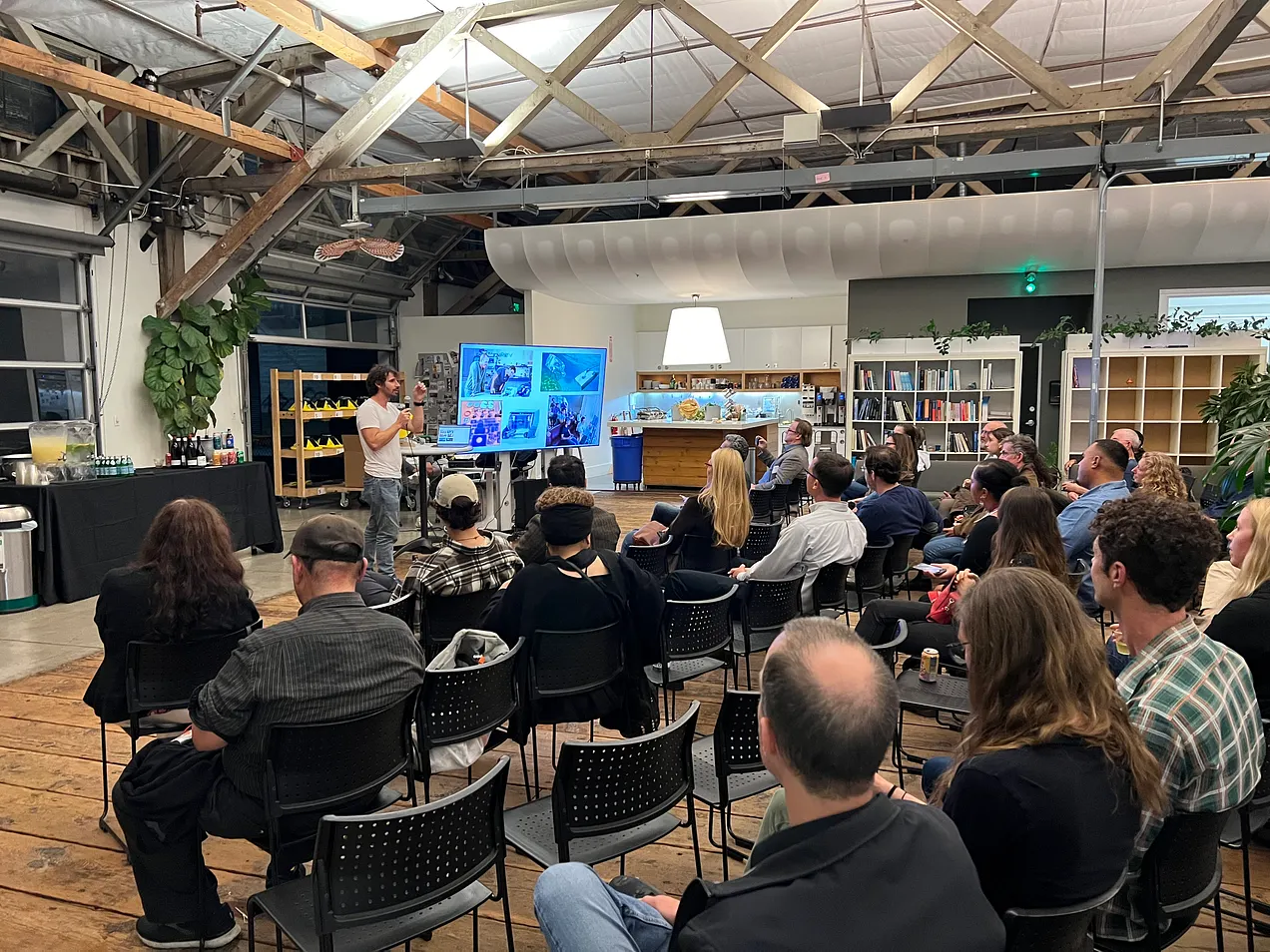
So I did what my own advice will tell you to do: I ran it by colleagues. David and Kate listened patiently while I explained Biological Threshold Calibration, and then, kindly, did not pretend to like it. I agreed. It really does sound like a methods section.
The three of us jumped into a quick Claude-fueled brainstorm. It got silly fast. Through every iteration, a single phrase held up. But before committing: I Googled it. It's important to check that your names aren't already tied to another scientific concept. It wasn’t. The name was free to adopt!
This is where I landed:
Living Thresholds - Using biology to refine the fixed environmental thresholds we rely on to predict ecosystem change.
I resonated with this name because “living” carries a lot of the meaning for the field. It conveys two ideas: thresholds informed by living things, and thresholds that can change instead of staying fixed. That double entendre gives the name a little tension, which turned out to be a good thing. It made people stop and think about what it could mean for their own work.
In the call for Living Thresholds, I asked for “living thresholds to complement and improve ecosystem forecasting,” and for researchers asking which biological variation makes an existing index predict outcomes better.
What grantees brought
One project is letting rock lobsters set their own living threshold. Instead of relying on oxygen levels alone, the team is using lobster physiology to combine oxygen and temperature into a measure of environmental stress. Using ocean glider observations and historical lobster walkouts, they will test whether this biologically informed threshold can better predict when conditions become so stressful that lobsters walk out of the ocean.
Another team is studying blue crabs in the Gulf of Maine. The crabs started showing up there during a decade of warming, but sightings dropped after two cold winters. This was not predicted by the usual species distribution models. However, those models are built on environmental conditions alone. This team wants to add what we know about blue crab physiology, like how much cold they can handle, to see if it improves forecasts of where their range ends. For them, the edge of the crabs’ range is the living threshold.
I didn’t see either of these interpretations coming, but they fit the call perfectly. That is exactly the kind of flexibility a good name gives you!
How to name a field
If you're facing the same blank box on the field builder application, here is what helped me:
Figure out what your name is anchored to. These names can be grounded in the question motivating the research, like Living Thresholds, but great names can also start from the tools or methods that unite a field. The Hyperspectral Biology grant program is named for a method, because a new way of reading biology from a distance is what makes that field possible.
Then:
- Collect — Write out a long list of keywords, tools, questions, and outcomes. What are the goals you’re excited about? What unites the researchers who are part of this nascent group?
- Simplify — Fewer words and details is often better. Look for the shortest phrase that carries most (but not all) of the meaning.
- Check for room — Would researchers from different places see their own work in it? Does it name a direction rather than prescribe a path?
- Evaluate — Does it already have different meanings that might cause confusion? Give someone you trust five possible names. Ask them to evaluate the strengths and weaknesses of each one. Do they feel alienated or turned off? Are they leaning in with interesting questions? Ask them one week later which one they remember. Remembering the name is more than half the job.
- Embrace a little weirdness — Would an outsider be curious about it? Great names can feel weird, they might have some tension or ambiguity. They’ll also by definition feel unproven, with many open questions embedded in them. That’s part of the invitation.
- Iterate!
Building a field name with this kind of flexibility is key to leading a program that invites creativity, while bringing together projects around a shared tool, idea, or outcome.
In the end, Living Thresholds is the name of a grant program: a number of projects, some researchers who liked the idea enough to apply, and a name I felt described the vision. I’m not the owner of this field. The name will belong to the people who find their work inside it. Whether it turns into a field is not something I decide on my own. If people keep using the name, argue about what belongs in it, and build on each other's work, it will stick.
Optogenetics was once just a new word too. I’ve put mine out there, and I’m excited to see who runs with it.